Discover My Writings
Discover My Writings
Discover My Writings
Novel
Veil Of Silence
Veil Of Silence
“It is when your spirit goes wandering upon the wind,
That you, alone and unguarded, commit a wrong unto others and therefore unto yourself.”
The Prophet. G.K. Gibran
Summary
In 1985, Beirut is ten years into a civil war. Fifteen-year-old Hoda dreams of a future with her secret boyfriend, a handsome, young militia leader. But her plans are thwarted when her parents force her into an arranged marriage with Tony, a rich man more than twice her age. Swayed by his generous gifts and attention, Hoda believes Tony’s promises of a better life, but within hours after they are wed, a pattern of abuse begins, and Hoda realizes she is trapped. Bound by religious law and tradition in a culture biased against women, Hoda is afraid to tell anyone of her misery, not even her best friend Rana and suffers in silence. Just when Hoda resigns herself to her fate an unexpected and forbidden love enters her life, which will cost her everything.
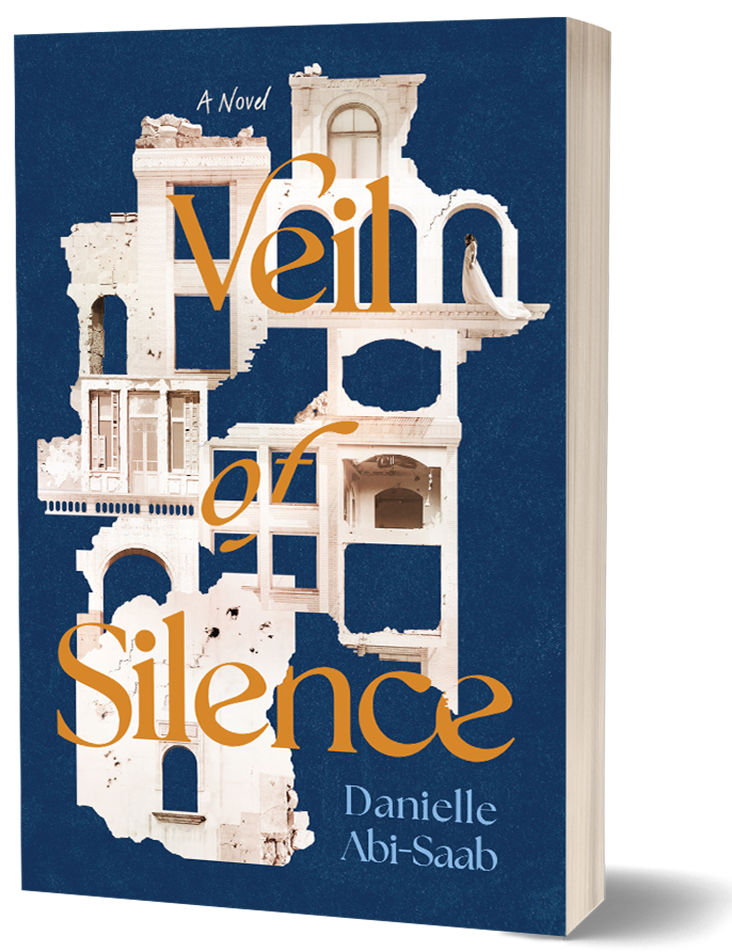
Publication June 2026
Excerpts from Veil of Silence
Watching from the balcony of her family’s apartment on the sixth floor, Hoda surveyed the damage. The smell of fire and burnt metal hung in the air. Broken glass, rubble, and de- bris from a neighboring building, now half-destroyed, blocked the road. Standing nearby, an old lady stared in silent sorrow at the gaping hole where her apartment had once been.
Hoda could make out Ammo Rashid’s figure on the other side of the street and hear him opening the metallic sliding doors of his shop behind the fortress of sandbags. Directly be- neath her balcony, a few ladies in their dressing gowns hugged each other. Snippets of their conversations reached her ears.
“Thank God for our safety, thank God we’re alive.”
“God will help us. We will rebuild.”
“They can destroy our buildings, but they cannot destroy our spirit. God is on our side.”
“Yalla.” Come on. “Let’s clean up. Boukra Inshallah the war will end.”
“Tomorrow, God willing. Tomorrow,” Hoda murmured, echoing their hope. Above all this chaos, the siren of an ambu- lance wailed in the near distance. At Hoda’s side, her mother, Fadia, broke down in tears, the devastation from the night’s intense shelling too much to bear in the bright sun of this glorious May morning. On the street, a man raised his voice in anger, shouting profanities at the sky, cursing the war, the bombs, his life.
Hoda turned to her mother and, noticing her tears, gave her a quick hug. “I’m going downstairs to help.”
Down at street level, the damage looked even worse. At the side of the building, the door to a small shrine to the Virgin Mary was busted, the glass completely shattered, yet the statue was unharmed. Hoda ran her hands over the figure in rever- ence, thankful that her home and family were unharmed.
Having known war for most of her life, fifteen-year-old Hoda had grown accustomed to these shellings and had built up a kind of immunity, a sort of resilience that was quite com- mon among her peers. She had mastered all too well the art of seeking shelter: keeping a bag always at hand filled with essentials—an extra sweater, a blanket, a bottle of water, some snacks, playing cards, sanitary pads, a box of tissue paper, a couple of candles, matches, and a flashlight—running to the basement at the first sound of a shell hitting nearby, and then waiting for the shelling to end.
She, her mom, her dad, and her older brother, Joe, had spent the last three days in a dingy basement with no elec- tricity or bathrooms, surrounded by neighbors, with just the basics they needed to make their stay more comfortable. Foul- smelling gas lamps had provided them with incandescent light that illuminated their card games, distracting them from the sound of the shelling getting closer. For three days, fire had rained down on their neighborhood from the nearby hills of West Beirut, by an artillery known as Stalin’s Organ, a multi- rocket launcher used by the Soviets during World War II. It was so called due to its terrifying hissing noise as it delivered more than forty shells in a quick succession, with one trajec- tory closely following the previous in a strict formation, and at a pace that could cause mass devastation in minutes in dense and cramped neighborhoods like Hoda’s.Located at the heart of East Beirut, Ain el-Remmaneh was only a few kilometers away from the west side of the city. Close enough for Hoda, like everyone else, to hear the departure sig- nal of the first projectile of each round of volleys, an empty, booming thud that lacked the gravity and bass of the inevita- ble incoming explosion. A thud that could hardly be ignored, since it signaled the arrival of thirty-nine more.
As the shelling grew nearer, they had huddled together, Hoda and Fadia on the bottom and the men on top, forming a mound of human bodies. With each blast, Hoda sought the warmth of her parents’ arms as they braced themselves for several minutes of intense shelling, praying and hoping against all hope they would be spared.
This is it! My wedding day!
Alone in the back of the car, Hoda had no one to encour- age her or hold her hand. A wave of anxiety overtook her, and her stomach churned. She signaled the driver to pull over, but they had arrived.
Hoda froze. Her heart pounded in her chest. Another wave of nausea flooded her. She swallowed an acid burp as it surfaced and threatened to spill out. Her hands trembled and her feet refused to move. Hoda looked outside and saw Tony standing tall next to his best man in front of the church’s wooden door. Tony looked proud, almost arrogant, in his dark navy suit, his light pink shirt, and his purple paisley tie. Hoda remained motionless. Her aunt opened the door, extended her arm to her, and gently coaxed her out.
“Yalla, Hoda, give me your hand. I’ll help you with your dress. Everyone is waiting. Are you OK?”
Hoda nodded and swallowed the lump in her throat. There was no time to explain. She stepped out of the car as her mother approached and fussed around her dress, tucking it in places and arranging her train and veil. She was greeted with cheers from guests who had stayed outside the church to watch her step out of the car. Dismissing her black thoughts, Hoda smiled and waved energetically at the crowd as they yelled her name.
There was no turning back.
After a night of heavy shelling, the neighborhood streets emerged slowly from a forced and sleepless hibernation. Residents of the largely Christian suburb moved out of their makeshift shelters—damp, windowless, unfinished base- ments with grubby concrete floors, or ground-floor hallway entrances, strewn with mattresses carefully hidden behind a wall of piled sandbags—that had provided more psychologi- cal respite than actual safety. Dazed yet relieved to be alive, those who’d survived the night were grateful to finally be in the sun, to see another spring day. All had, by this point in the war, willingly or unwillingly adapted to this routine: lying low during dangerous times and emerging during calm days to re- pair whatever could be saved.
Watching from the balcony of her family’s apartment on the sixth floor, Hoda surveyed the damage. The smell of fire and burnt metal hung in the air. Broken glass, rubble, and de- bris from a neighboring building, now half-destroyed, blocked the road. Standing nearby, an old lady stared in silent sorrow at the gaping hole where her apartment had once been.
Hoda could make out Ammo Rashid’s figure on the other side of the street and hear him opening the metallic sliding doors of his shop behind the fortress of sandbags. Directly be- neath her balcony, a few ladies in their dressing gowns hugged each other. Snippets of their conversations reached her ears.
“Thank God for our safety, thank God we’re alive.”
“God will help us. We will rebuild.”
“They can destroy our buildings, but they cannot destroy our spirit. God is on our side.”
“Yalla.” Come on. “Let’s clean up. Boukra Inshallah the war will end.”
“Tomorrow, God willing. Tomorrow,” Hoda murmured, echoing their hope. Above all this chaos, the siren of an ambu- lance wailed in the near distance. At Hoda’s side, her mother, Fadia, broke down in tears, the devastation from the night’s intense shelling too much to bear in the bright sun of this glorious May morning. On the street, a man raised his voice in anger, shouting profanities at the sky, cursing the war, the bombs, his life.
Hoda turned to her mother and, noticing her tears, gave her a quick hug. “I’m going downstairs to help.”
Down at street level, the damage looked even worse. At the side of the building, the door to a small shrine to the Virgin Mary was busted, the glass completely shattered, yet the statue was unharmed. Hoda ran her hands over the figure in rever- ence, thankful that her home and family were unharmed.
Having known war for most of her life, fifteen-year-old Hoda had grown accustomed to these shellings and had built up a kind of immunity, a sort of resilience that was quite com- mon among her peers. She had mastered all too well the art of seeking shelter: keeping a bag always at hand filled with essentials—an extra sweater, a blanket, a bottle of water, some snacks, playing cards, sanitary pads, a box of tissue paper, a couple of candles, matches, and a flashlight—running to the basement at the first sound of a shell hitting nearby, and then waiting for the shelling to end.
She, her mom, her dad, and her older brother, Joe, had spent the last three days in a dingy basement with no elec- tricity or bathrooms, surrounded by neighbors, with just the basics they needed to make their stay more comfortable. Foul- smelling gas lamps had provided them with incandescent light that illuminated their card games, distracting them from the sound of the shelling getting closer. For three days, fire had rained down on their neighborhood from the nearby hills of West Beirut, by an artillery known as Stalin’s Organ, a multi- rocket launcher used by the Soviets during World War II. It was so called due to its terrifying hissing noise as it delivered more than forty shells in a quick succession, with one trajec- tory closely following the previous in a strict formation, and at a pace that could cause mass devastation in minutes in dense and cramped neighborhoods like Hoda’s.
Located at the heart of East Beirut, Ain el-Remmaneh was only a few kilometers away from the west side of the city. Close enough for Hoda, like everyone else, to hear the departure sig- nal of the first projectile of each round of volleys, an empty, booming thud that lacked the gravity and bass of the inevita- ble incoming explosion. A thud that could hardly be ignored, since it signaled the arrival of thirty-nine more.
As the shelling grew nearer, they had huddled together, Hoda and Fadia on the bottom and the men on top, forming a mound of human bodies. With each blast, Hoda sought the warmth of her parents’ arms as they braced themselves for several minutes of intense shelling, praying and hoping against all hope they would be spared.
“Yalla, Hoda, give me your hand. I’ll help you with your dress. Everyone is waiting. Are you OK?”
Hoda nodded and swallowed the lump in her throat. There was no time to explain. She stepped out of the car as her mother approached and fussed around her dress, tucking it in places and arranging her train and veil. She was greeted with cheers from guests who had stayed outside the church to watch her step out of the car. Dismissing her black thoughts, Hoda smiled and waved energetically at the crowd as they yelled her name.
There was no turning back.
Meet some of the characters
Hoda
Tony
Hoda’s demeaning and domineering husband.
Rana
Hoda’s best friend who secretly pines for Hoda but hides behind her academic achievements.
Recipes from Veil Of Silence
Recipes from Veil Of Silence
Homemade
Manakish
Sift the dry ingredients together in a bowl. Make a well in the middle & add the oil. Add the milk & knead well until the dough separates from the bowl…
Poems
“Joy”
They found joy
Despite the hardships
The everyday hassles,
The financial crisis,
The lack of electricity,
Of water,
Of needed medications
Despite the corruption
The explosion
That left the city broken
Destroyed
In ashes and tears.
They found joy
In recounting tales
Of times long ago
When life was good
And worry-free
In laughing
At their character flaws.
In being together
Under the stars at night
And the rising moon above
In the sharing of a cup
Filled with a golden nectar
Fruit of their vineyards.
They found joy
Where there was none.
“Hurting”
I didn’t ask to be born
I did not ask for war
For the fear
For the gloom
For anxious nights
Waiting to die.
I did not ask to be hungry
For the pangs
Of pain
For days waiting
For a coin
For a piece of bread.
I did not ask to be homeless
To sleep under a bridge
To shiver
To feel the concrete
Under my bare bones
To wait for the dawn
Hoping, praying
To find a home.
I did not ask to be scared
To cower
To hide
In a closet
Waiting for the shooting
To stop.
I did not ask
For the bruises
For the scars
On my body
And in my soul
Waiting to be safe
Waiting to be loved.
I only ask
For my dignity
For my daily bread
For a roof
Over my head
I only ask
For respect
A bit of love
And peace of mind.
Poems
Poems
“Joy”
They found joy
Despite the hardships
The everyday hassles,
The financial crisis,
The lack of electricity,
Of water,
Of needed medications
Despite the corruption
The explosion
That left the city broken
Destroyed
In ashes and tears.
They found joy
In recounting tales
Of times long ago
When life was good
And worry-free
In laughing
At their character flaws.
In being together
Under the stars at night
And the rising moon above
In the sharing of a cup
Filled with a golden nectar
Fruit of their vineyards.
They found joy
Where there was none.
“Hurting”
I didn’t ask to be born
I did not ask for war
For the fear
For the gloom
For anxious nights
Waiting to die.
I did not ask to be hungry
For the pangs
Of pain
For days waiting
For a coin
For a piece of bread.
I did not ask to be homeless
To sleep under a bridge
To shiver
To feel the concrete
Under my bare bones
To wait for the dawn
Hoping, praying
To find a home.
I did not ask to be scared
To cower
To hide
In a closet
Waiting for the shooting
To stop.
I did not ask
For the bruises
For the scars
On my body
And in my soul
Waiting to be safe
Waiting to be loved.
I only ask
For my dignity
For my daily bread
For a roof
Over my head
I only ask
For respect
A bit of love
And peace of mind.
Short Story
Melancholia
Melancholia
The night was pitch black. A thick canopy of trees obscured the city lights where a young man lay sleeping. He opened his eyes. He felt the cold wet grass underneath him. A pebble poked at his back. He shivered. He sat up and stared ahead unable to recognize his surroundings. A long wail escaped his lips, followed by smaller and smaller sobs, until there were none left. He was completely lost. He stood up. His heart pounded in his chest. He heard his own breath, shallow and panting like a lost puppy. His eyes slowly adjusted to the dark. Up ahead, two tall trees stood still by a kiosk where a man was curled up snoring. He recognized the grounds. He heard the sound of a train clanking then screeching to a halt. He glanced behind him, relieved to see the lights of the train station. He breathed more slowly. He remembered leaving the bar but nothing else.
Melancholia
He was back home in the middle of his first semester abroad at Queen Mary University of London. He was home for a short visit. To recharge. He was back to the city where he had lived for the past five years, back to Hofheim – a town near Frankfurt – back to his parents’ home. In London, he had occupied a small dorm room at the end of a long sterile corridor of rooms. Barely four feet separated his bed from a wooden desk topped by a bookshelf where books, loose papers, folders, pens and pencils lay scattered at all times. The bed was bare save for a green and grey blanket hand-knitted by his mother – the only comforting item in the room. He hardly heard the sound of other students congregating in the kitchen and lounge at the other end of the corridor. He rarely joined them. Nor did he join any other student activity. He didn’t care to. Every morning he plodded onto Mile End Road before he turned onto Westfield Way to his classes and every evening he made the trip back to his dorm room. Mile End Road was too loud for his sensitive ears and most of the times he preferred walking through the park. Though it took him a little longer, at least it was quiet and peaceful. Winter days were very short in London. By the time he got back to his dorm room, night would have already descended. Most evenings, he stayed in bed staring at his laptop watching YouTube videos. He ate very little, mostly vegetarian meals at a Lebanese restaurant nearby. He was losing weight. He started skipping classes, confining himself to his room. He stopped calling his mother. He stopped answering her calls.
He sat on his bed staring at the empty wall with the laptop resting on his lap. The sky was grey and heavy with rain. He stayed in, cuddled in his pajamas despite the late morning hour. He convinced himself he needed to catch up on his homework. A copy of Introduction to Creative Writing lay on one side, the page secured by a travel mug the tea inside of which had long gone cold. On the other side Spark’s The Prime of Miss Jean Brodie – this week’s assignment – remained unopened, looking pristine. The only light in the room came from his laptop. The cursor blinked on the empty word document page.
Facetime rang and rang. He finally answered. His mother’s face stared back at him. On the corner of the screen he saw himself: red swollen eyes, unshaven, emaciated face. The same face that his mother saw too on the other end of the screen.
“What’s the matter baby? You look sad.” He recognized his mother’s worried tone, her attempt at containing her panic.
“Nothing mom. I…” His mother waited a few seconds for him to continue.
When he didn’t, she chattered on. She spoke of the cat’s latest adventure at the neighbor’s house. She tallied his sister’s most recent purchases. She recounted her encounter with the new boss. She joked. She cajoled. She kept it light. He remained demure. She tried reeling him in but nothing seemed to work. She was running out of options.
“You need to recharge,” she realized as she said it.
“Why don’t you come home for the weekend? Would you? Would you please come home for the weekend?” She pleaded. She held her breath, waiting. She saw his eyes lighting up. She saw a glimmer of a smile. She exhaled, relieved.
“I will book you a ticket right now. I’ll send it by email. Let me know when you get it.”
He nodded.
“I will call you tomorrow morning to make sure you’re on your way.”
“Mom, it’s OK. I’ll be OK. I will make it home. I promise… I miss you.” He let his voice trail off.
His mother suppressed a moan. “I love you my baby. See you tomorrow.”
He ignored the alarm for ten minutes until he heard a loud knock on the door. “Get up man! Get up! Your alarm is driving me crazy!” He jumped out of bed thankful for this stranger. The phone rang.
“I’m getting ready mom.” He replied exasperated. “I’ll text you when I’m on my way to the airport.” He packed sparingly then walked towards his university. From there he took the Central Line to Stratford then caught the Docklands Light Railway to the airport. He texted his mother every step of the way. He relaxed once on the plane and texted his mother: “boarded. See you in Frankfurt. Heart emoji.”
His mother picked him up at the airport. She locked him in a long embrace. He loosely laid his arms on her shoulders. She did not insist. On the drive home, he sat morose. His mother filled the silence with idle chatter. “Your sister will be at school when we get home. She knows you’re coming. She’s very happy to see you.” “Me too.” was Philip’s short answer.
“How was the flight?”
“Fine.”
Her attempts on engaging him in a conversation remained futile. Her questions received monosyllabic responses: yes, no, sure and the likes. Nothing more.
They ordered pizza for dinner because he loved pizza. He ate only one slice even though it was Hawaiian, his favorite. His sister Sarah made popcorn. They watched a comedy on Netflix. He barely laughed. He barely touched the bowl of popcorn. His mother eyed him anxiously.
“Is everything OK?” Sarah asked.
“Just tired. I’m going to bed.” Philip replied.
His mother tucked him into bed. She kissed him on his forehead and stroked his hair gently. “Sweet dreams my baby” she said softly as she closed the door behind her. He stared at the pictures on his wall. Even in the dark, he could distinguish the blue colored spray-painted image of the Roman colosseum under a huge silver moon. Tears streamed down his face as he recalled their last family trip together, the four of them. At the foot of the colosseum, a young artist with spray paint bottles was selling his wares. Philip chose a small one for only seven euros, the cheapest option, but his dad insisted on buying him the bigger format. He turned his back to the picture and closed his eyes. He heard his mother pacing back and forth outside his room. Her steps like a metronome, grew louder marking the beat as she approached his room then faded as she moved further away in the small corridor. He fell asleep.
He woke up in time for lunch. His mother had taken the day off. His sister had already left to her basketball practice. The day passed by uneventful, his mother catering to his every need. They baked cookies together, drank hot chocolate, played Boggle. He called it quits after three consecutive lost rounds; one to his sister and two to his mom. An unusual occurrence. “I have an assignment to finish.” He crammed the boggle board into its box and rammed the lid on. He spent the rest of the afternoon in his room. Around seven in the evening, he came down the stairs. He was clean shaven and his hair was tied into a ponytail.
“I’m meeting my friends in town. I’ll make sure to catch the last train home.” He announced.
“Are you sure you will be OK?” His mother asked anxiously.
“Yes, mom. Don’t worry. I’ll be OK.” He lied.
“Don’t drink too much”.
He remembered his mother’s last words now that he was in the park. He remembered meeting his friends. He remembered the awkward silence until they all started drinking. He remembered the bar with its dark wooden atmosphere, the green dim lights, the smell of liquor permeating the stale air. He remembered ordering beer after beer. He had stopped counting. He remembered feeling giddy at first, boisterous even, laughing loudly. Sometime past midnight, his mood darkened. He remembered leaving the bar. He had to catch the last train home. He never made it to the train station though he was only minutes away. He looked at the time. Five seventeen AM. Another wave of panic hit him. The last train home was long gone. He had spent the night… His mind went blank: where? In the park?
He felt clammy. His head hurt. He ran his fingers in his hair, massaging his temples. His sleeves were stiff. He pulled to loosen them off and felt a warm liquid ooze out. Blood! He uncovered his left sleeve. Several jagged shallow slits ran from his wrist up his elbow. The smell of beer, stale and pungent wafted with a gentle breeze. Broken beer bottles lay at his feet. He grabbed a piece. Blood seeped out as he ran his fingers along its sharp edge. He felt alive again. The blood was warm, soothing. It reminded him of his parents’ living room, flames dancing in the fireplace, the smell of burnt wood mixing with roasting chestnuts – his mother’s favorite. He saw his dad sitting in his favorite spot with the cat nuzzling the back of his head. He missed him. He missed the days when life was simple, when he wasn’t troubled by dark thoughts. He stared at the growing red spot. So physical, so tangible. Unlike the vast emptiness of his heart. Thoughts of death flooded his mind.
He was tired of pretending. He was tired of hiding away his emptiness. Tired of putting up a stoic front. He wished he could just stop. He eyed the piece of glass then looked at his wrists. A car passed by breaking his trance. He looked up at the sky. The stars were sparkling like diamonds on this moonless night. He became aware of an incessant buzz. His phone! He looked at his screen. Twenty-one missed calls. He picked up. “Hello” his voice came out shaky, barely audible. He heard a heavy sigh of relief at the other end and his mother’s trembling voice “Philip! Thank God.”
That evening, Anne had received a text from her son: “I’ll take last train F to H. Can you pick me up? Thanks.” She waited at the train station in Hofheim. She stood outside her car by the hairdresser and scrutinized the few people as they hurried off the train. She could hardly see against the hairdresser’s bright lights. The figures became more obvious as they moved towards her. A young girl, an old man, two teenagers, then another young man but not Philip. The train left. Philip wasn’t there. She ran after the train calling his name. She stopped at the end of the platform, out of breath, her heart pounding. She stood there watching the train disappear into the night. She called his cell. No answer. “Where are you? Where are you?” She kept repeating. Cold sweats ran down her forehead. She got back into her car. She sat for a few minutes until she stopped shaking then drove home. Did he catch the tram instead? Had their paths crossed on the way home to the station? Was he already home? Her hands clutched the steering wheel tightly, afraid of letting go. She drove at the edge of the speed limit, aware of the police care that was waiting on the bridge. Her thoughts vacillated between hope and despair. He was home. He was not home. She remembered the sitcom were a nerdy character explained Schrodinger’s cat to his roommate only partially registering it. But now its full implication hit her. He was home. He wasn’t home. During this ten-minute drive, both were possible.
Anne didn’t bother parking in the garage. She grabbed her purse, slammed the car’s door shut and ran to her front door. Her hands trembling, she fiddled with the key until it fit in its hole. She threw her purse on the floor and stopped at the bottom of the stairwells. She willed herself to breathe slowly. She didn’t want to wake up her daughter Sarah. Anne tiptoed up the stairs to Philip’s room. She opened his door with trepidation. He wasn’t there! She suppressed a cry. She ran down the stairs into the living room and called Ethan. She then called James. They both had the same answers.
Yes, I was at the bar with Philip.
Yes, I saw him leave. He was headed to the train station.
A little after 1:00 AM to catch the last train to Hofheim.
No, I haven’t seen him since.
She drove down to the train station in Frankfurt. She searched frantically along platform one hundred three, hoping to catch a glimpse of his curly hair, of his clothes, of anything that heralded his presence. Maybe he had fallen asleep waiting for the train. She expanded her search to include neighboring platforms, then many other platforms but the main station in Frankfurt was too large. She stayed there for hours, searching, retracing her steps, looking in places she could have missed earlier. She talked to the policeman at the station. She gave them his specifications: eighteen-year-old, curly brown hair that ran down to his shoulders but tied into a ponytail, blue eyes, wearing a pair of blue jeans, and a long-sleeved green and blue plaid shirt. Jacket? Was he wearing a jacket? She couldn’t remember. She started crying. How could she not remember that detail? She searched her wallet and brought up a photo – Philip aged fifteen. He hasn’t changed much, only slightly thinner. The police took note of her descriptions then sent her home. They would call with updates, if any. She drove around town hoping to find him, to see him walking somewhere. She couldn’t get herself to return home. She called him every ten to fifteen minutes, her heart beating hopefully with every call, then wildly when he didn’t pick up. Until finally he picked up! At five twenty-five in the morning! “Philip! Thank God.”
He listened to his mother’s soothing voice punctuated here and there with the command: “Do not hang up! Stay where you are until I find you.” He obeyed. He stayed on the phone until he saw her running through the park. He felt her arms around him while his remained limp on his side. He tasted the salt of her tears. He tried to speak. Instead he broke down crying. He let her guide him to the car. He let her walk him up the stairs to their living room. She lit a fire. He watched as it crackled in the hearth. He was safe. For now.
His mother handed him a glass of water. “You need to hydrate.” She wrapped him in a warm blanket. “I’ll heat some soup. Are you hungry?”
“No, mom. I can’t. Not now. I want to rest.” She guided him to his room. He fell asleep with his clothes on.
“He’s safe.” Anne thought to herself as she went down the stairs.
“He’s home now.” She repeated out loud. She closed the fireplace door and turned out the lights.
“He is safe. He is home now!” Anne repeated to herself. She collapsed on the couch. She stared at the dancing flames and fell asleep. She woke up to the sound of her daughter’s footsteps coming down the stairs.
“Mom? Are you OK? Why are you sleeping down here?”
“Yes, everything is good. Don’t worry. Just get yourself ready for school. I’ll drive you.”
“But mom…”
“Sarah, please don’t argue with me. I had a terrible night.”
“Mom, it’s Sunday!”
“Your brother… your brother…” Anne couldn’t continue, couldn’t find her words. She covered her face and sobbed. Sarah hurried up the stairs then ran back down. She gave her mother a big reassuring hug: “He’s ok. He’s sound asleep.”
Anne opened her laptop. She started her search: “Frankfurt psychiatry clinics”. The search yielded several clinics and a university hospital, all in German. Despite living in the area for the past five years, her German was very limited. Her son’s German was better but nowhere fluent enough to talk to a psychiatrist. So she tried “English-speaking psychiatrists in Frankfurt”. A long list of psychiatrists and psychologists came up. A nerve-wracking task, she sifted through the long list, one name after another. She finally found one with a welcoming post:
“Do you often feel sad and lonely? Do you drink too much? […] There may be situations in life where you realize that you need help to overcome them…”
A good start, she thought. She would need to clear it with her insurance company. But first she needed to convince Philip and she needed an ally – Sarah.
Philip came into the living room in the late afternoon to find his sister and mother sitting on the couch, chatting in hushed tones. They stood up like soldiers on alert upon seeing him. His mother looked ten years older. Her face furrowed. Her eyes puffy and red looked ghastlier by the deep dark circles around them. “Mom” was all he managed to say before she grabbed him in her arms in a bear hug.
In between her sobs, she whispered, “don’t …. you ever…do that again… to me.” She was shaking so badly she had to sit down.
Philip uttered a barely audible: “I’m sorry” and stood there, unable to move. He saw the depth of her sorrow. He looked away.
“Philip, we’re worried about you.” His sister said calmly. “Come sit.” She patted the seat next to hers. Philip obliged.
“I know.”
A long silence followed.
“Is it London? Is it lonely over there?” His mom broke the silence.
Philip nodded. “I missed you guys. Things are simpler at home. I thought I could make it on my own. I thought things would be different.”
“Different how?” Sarah asked.
“I don’t know.” He paused. “I feel strange, like I don’t belong. I don’t think people like me.”
He dropped his head. Tears fell down on the leather couch leaving water marks. “My sweet boy. You know I love you so much.” His mom pulled him closer to her side. He let his head drop onto her shoulder. She wrapped her arm around him and stroked his hair.
“I love you too.” Sarah continued, the volume of her voice increasing with each sentence. “But why would you say something like that?”
“I … I” Philip stammered. “I don’t know. My head is full of questions. My thoughts are always jumbled.” His voice trailed off. “I don’t know who I am.”
You’re a great guy!” Sarah reassured him.
“I don’t think so.”
“You are! Phil, you have to believe me. Everybody loves you.”
Philip attempted a smile.
“I don’t know”, he replied meekly, averting her gaze.
“What are you talking about?”
“Well why would they? What’s there to like…” he trailed off. “Can’t you just drop it. Please Sarah!” He implored. “I’m done. I’m tired. I want to rest.”
Phil stood to leave but Sarah wouldn’t relent.
“No Phil. No, I won’t just drop it. Listen to me! Do you remember our last get together? You were great. Everybody cheered when you tackled that horrible Rodney. You stood up to this bully when no one else dared. You’re a hero. You’re my hero.” Sarah rested her head on his shoulder then added: “That’s who you are and will always be.”
Philip remembered that day well. He and his sister were among a well-knit group of friends celebrating the end of the school year. They had gathered at a spot near the Holbeinsteg bridge on the Main promenade in Frankfurt. Bottles of beer and Somersby were cooling in the water fully submerged in the river securely attached in a bag. The night was warm, the moon was bright, and the mood light and happy. The lively chatter was suddenly interrupted by the arrival of Rodney, drunk and belligerent. He pestered a young girl then turned his attention to Sarah. But before he could say or do anything, Philip had already lunged at him pinning him to the ground. Though Rodney managed to escape soon after, everyone complemented Philip for his bravery.
“It’s not that simple. Just leave me be Sarah. I don’t want to talk about it.” He yelled as he pushed her off his shoulder.
“Phil, baby, please calm down.” His mother finally spoke up. “We need to talk. We need to understand. I need to understand.” Anne stopped mid-sentence, choking. She coughed before continuing. Her voice quivered: “I’m sorry baby. I failed you. I failed to see you were suffering and yet I pushed you to pursue to leave home, to study abroad.” Anne broke down crying. Tears poured uncontrollably. She sniffled and wiped the tears with the back of her hand.
“Mom, it’s not you. I’m tired. Please. I’m tired. Can we talk about this later.”
“No!” She yelled, startling both kids as she stood up. “We need to talk now. You’re not going anywhere until you do.” And as quickly she slumped back onto the couch.
Philip stared at her, angrily for quite some time. Anne held his gaze through her tears. He saw the hurt in his mother’s eyes. His anger melted away.
“I don’t know. I feel numb inside, like something is missing.” He finally admitted.
“Is that why you cut yourself?” Sarah asked.
“And is that why you drank so much yesterday?” His mother chimed in simultaneously.
“I don’t!” He lied emphatically.
Sarah looked at him tenderly and lifted his sleeve up, revealing the fresh slits.
His mother gasped.
Philip hurriedly pulled his sleeve down. “I’m sorry mom.” He mumbled.
“I drank because.” He hesitated. A long sigh escaped his lips. “Because I don’t fit. I have nothing to say, not even to my friends. I can’t face them. I feel ashamed. All the time.”
Philip stood up to leave but his mother pulled him back down. He almost fell back onto the couch. “What the heck?” He shrieked.
“Philip, stop! Stop it right there. Stop running. Stop!” Her fists clenched; Anne pounded the couch. “Talk to us! Don’t just turn and walk away. Face us. Face your feelings. You can’t hide from them by drinking or cutting. You can’t. You have to stop!” His mother seethed.
“How mom? How? Please tell me!” Philip stood tall facing his mother. “If I let myself feel, then it’s only pain and it hurts so much. It hurts so much mom.” He collapsed back onto the couch. “I can’t. I can’t. I can’t.” He clutched his heart.
“You have to.”
“You have to.” Sarah insisted. “You have to live. You have to let yourself feel. Pain. Joy. Love. Sadness. All of these. You have to let yourself feel all of these. They make us human.” Anne looked at her daughter in bewilderment. When did she become so wise?
“Your sister is right, baby. You can’t run from your feelings.”
She took a long deep breath. “I found this psychiatrist in town.” Philip’s eyes widened. Anne continued: “I don’t know how to help you. I want to but I don’t know how. I know that I love you and your sister more than anything in this world. But I too feel helpless. I can’t bear to see you sad, or hurt. Yesterday was a nightmare. I don’t want to ever live through that again.”
She stopped to wipe her tears. “I will call his clinic tomorrow and book an appointment. We will go together. And we will decide together if that is the right path for you.”
“What about school?” Philip asked.
“You’re not returning to London. At least not now. You will return once you get better. I will call the school. I will take care of this.” His mother looked at him anxiously. She wanted him to be independent, to rely on himself, but he was too vulnerable now. He needed her. He needed to stay home. She had to trust her instincts.
“I, I” He stammered before continuing. “I don’t want to return to London.” He said, relieved that his mom was in charge. Relieved to stay home where he felt safe. He breathed more slowly. He sat back down between his mother and sister. He hugged them. He promised he would go to the clinic. He promised he would get treatment. He promised he would get better. He promised not to drink anymore.
Several months of therapy and antidepressants followed. The emptiness withered away like fog in the morning sun. He laughed more often. He met his friends but did not need alcohol to relate. He took the rest of the school year off. He joined a band and played his saxophone. He was finally on the road to recovery, on the road to finding himself.